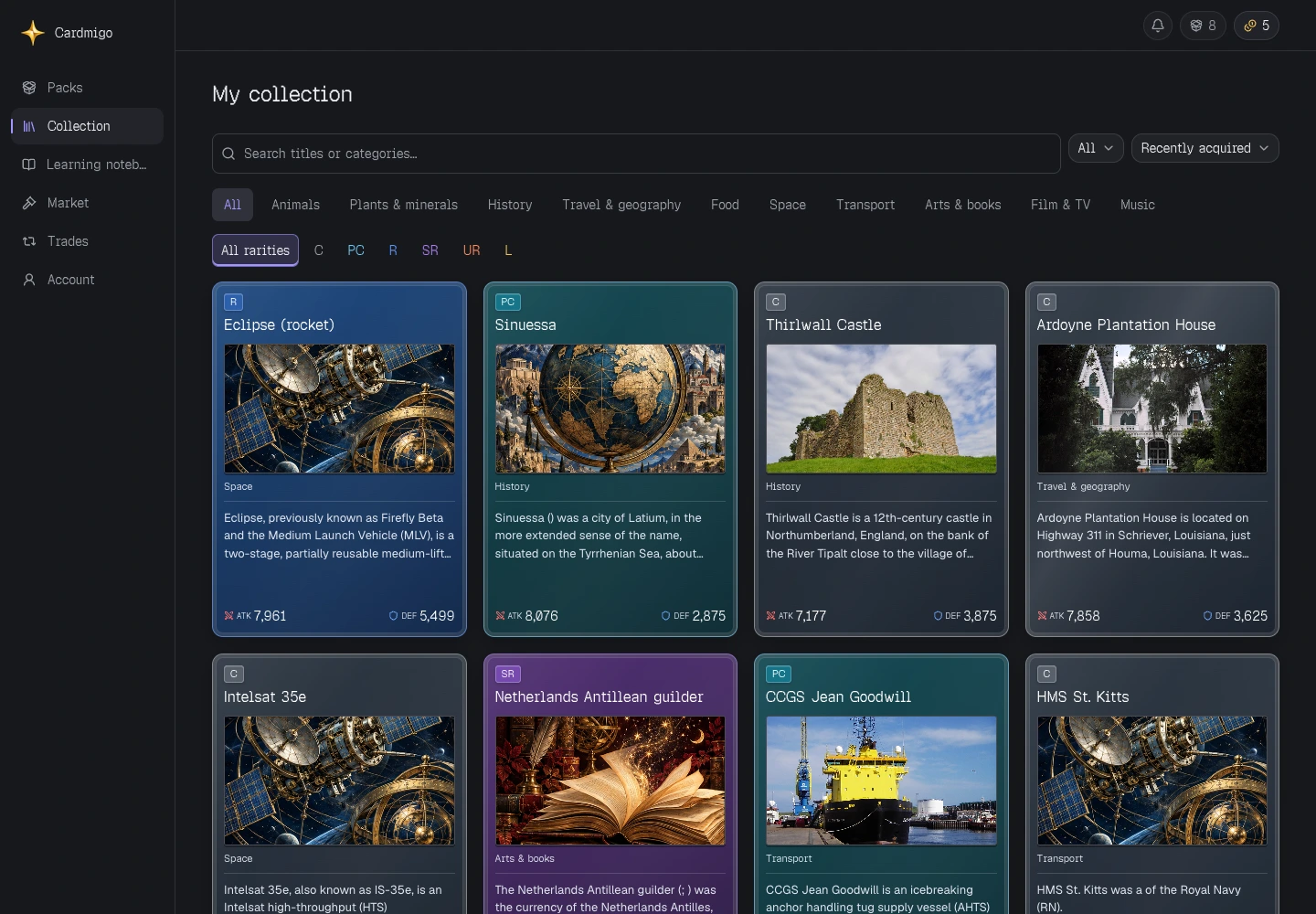
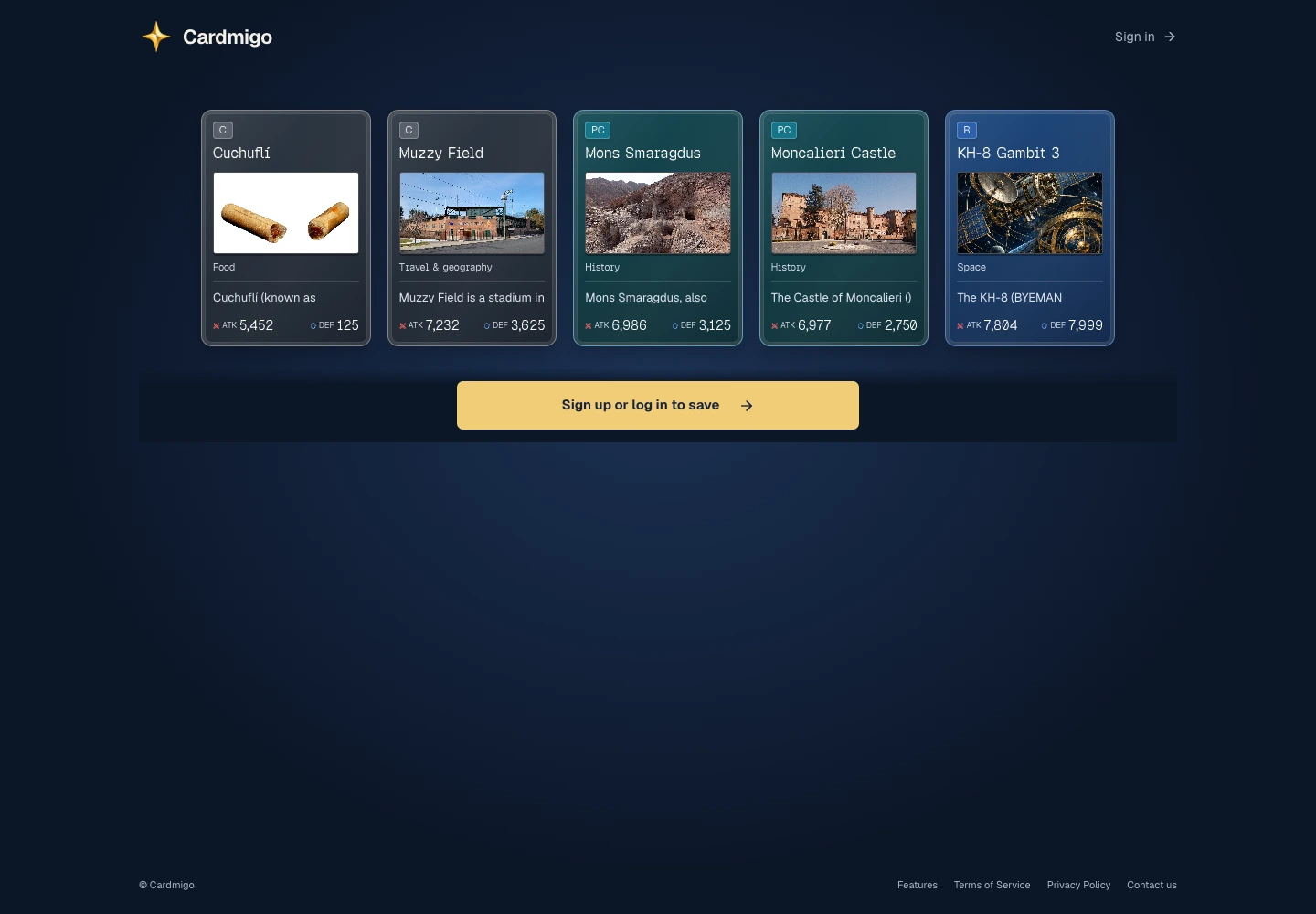
 Cardmigo
Explore Wikipedia one card and one question at a time
An interesting encyclopedia visit often begins with one detail you cannot explain. A card gives you a subject. Your next question gives you somewhere to go.
Begin with a question small enough to follow
You do not need to read an entire article to make a worthwhile discovery. Start with the card’s name, picture and short description. Write a question you could answer in a few sentences.
“Tell me everything about animals” is difficult to finish. “Why does this adult salamander still have external gills?” gives you a place to look. “What is this spacecraft?” becomes more interesting when you ask what it was sent to investigate.
Try one subject, one question and one useful connection. Treat that as a flexible way to explore, not a timed challenge or a promise that you will remember everything.
Follow an axolotl from appearance to life cycle
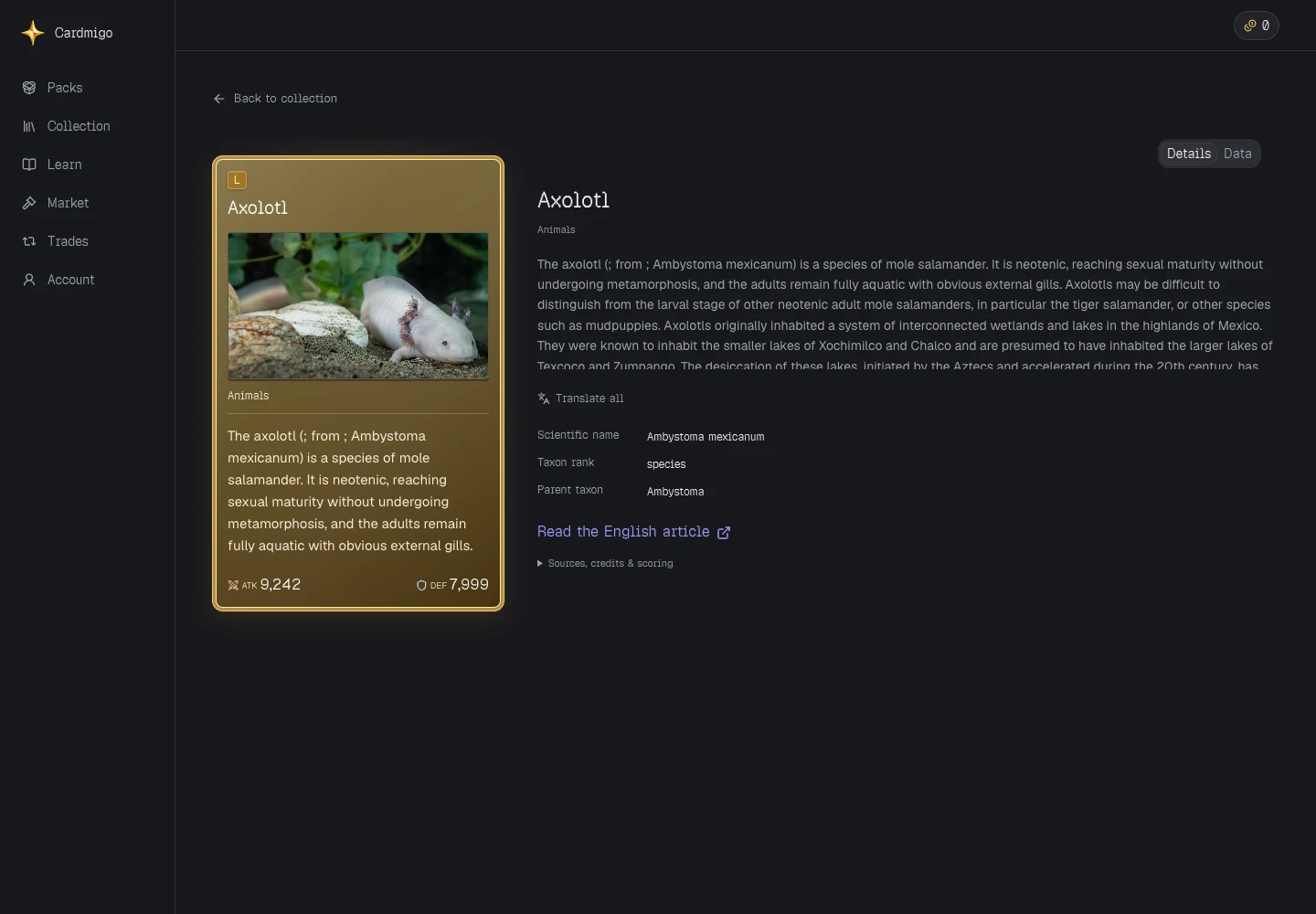
The axolotl’s feathery external gills are a good reason to look twice. It is a salamander that normally retains larval features as an adult. That turns a striking picture into a question about how animals develop.
Open the Axolotl card, then follow the source article to the sections about development and neoteny. Try explaining the difference between retaining a feature and simply being a young animal.
When a word such as “neoteny” makes you stop, first read the sentence around it. Look up the term if needed, then return to the original passage. The term is more useful when it helps answer your question.
Use a tardigrade to practise reading the limits
Tardigrades are microscopic animals, and some can survive extreme conditions by entering a dormant state. That fact invites a better question than “Are they indestructible?” Ask what conditions, what state and what kind of survival the evidence describes.
Start with the Tardigrade card and read the article’s environmental-tolerance sections. Look for the qualifications around broad claims. Surviving a particular exposure is different from living and reproducing normally in that environment.
This habit transfers beyond animals. Whenever a striking claim appears, ask what the source actually measured and what it leaves open. A memorable card can be an invitation to investigate the detail.
Follow Voyager 1 as a journey
Voyager 1 launched in 1977 and flew past Jupiter and Saturn before continuing towards interstellar space. Instead of trying to memorise a changing distance figure, follow the sequence of the mission.
Open the Voyager 1 card and check the mission timeline in the source article. What did each stage make possible? Which observations belonged to a planetary flyby, and which came much later?
For another connection, browse the space discovery page and choose a different subject. A mission, a celestial object and an astronomical image each tell a different kind of story. You do not have to turn them into a single checklist.
Leave yourself a useful trail
Before moving on, say the answer to your original question in your own words. If you cannot yet explain it, find the part that remains unclear rather than adding several unrelated tabs.
You can mark a card as a favourite and return to the subject later. If you are reading English and want to revisit a word, Cardmigo’s vocabulary notebook lets you manually save useful vocabulary with context and its source card after signing in.
Save selectively. A word you want to use or a phrase that helped you understand the subject gives you a clearer reason to review than a long list collected automatically. Translation and pronunciation can be imperfect; check the original passage and source when the distinction matters.
Let the next subject come from your curiosity
At the end of a small reading session, choose a next question rather than a target number of packs. You might compare another amphibian, look at a different microscopic animal or follow another space mission.
Cardmigo’s animal guide and space guide contain selected real subjects and reading prompts. They help you browse; they do not guarantee the theme or subjects of a random card pack.
If you are starting a collection, the beginner’s guide explains previewing and keeping your cards. You can enjoy discovering a subject before deciding how large a collection to build.
Sources & further reading
Written by Cardmigo. Product rules can change; check the linked official pages for current details.
Your next discovery
Find a real subject, choose a question and follow its story.
Explore unusual animals