
← Discover

Six unusual animals. Six wonderful detours.

An egg-laying mammal. A giraffe’s unexpected relative. A tiny animal built for extremes. Start with a surprise, then follow the science.

Start exploring ↓
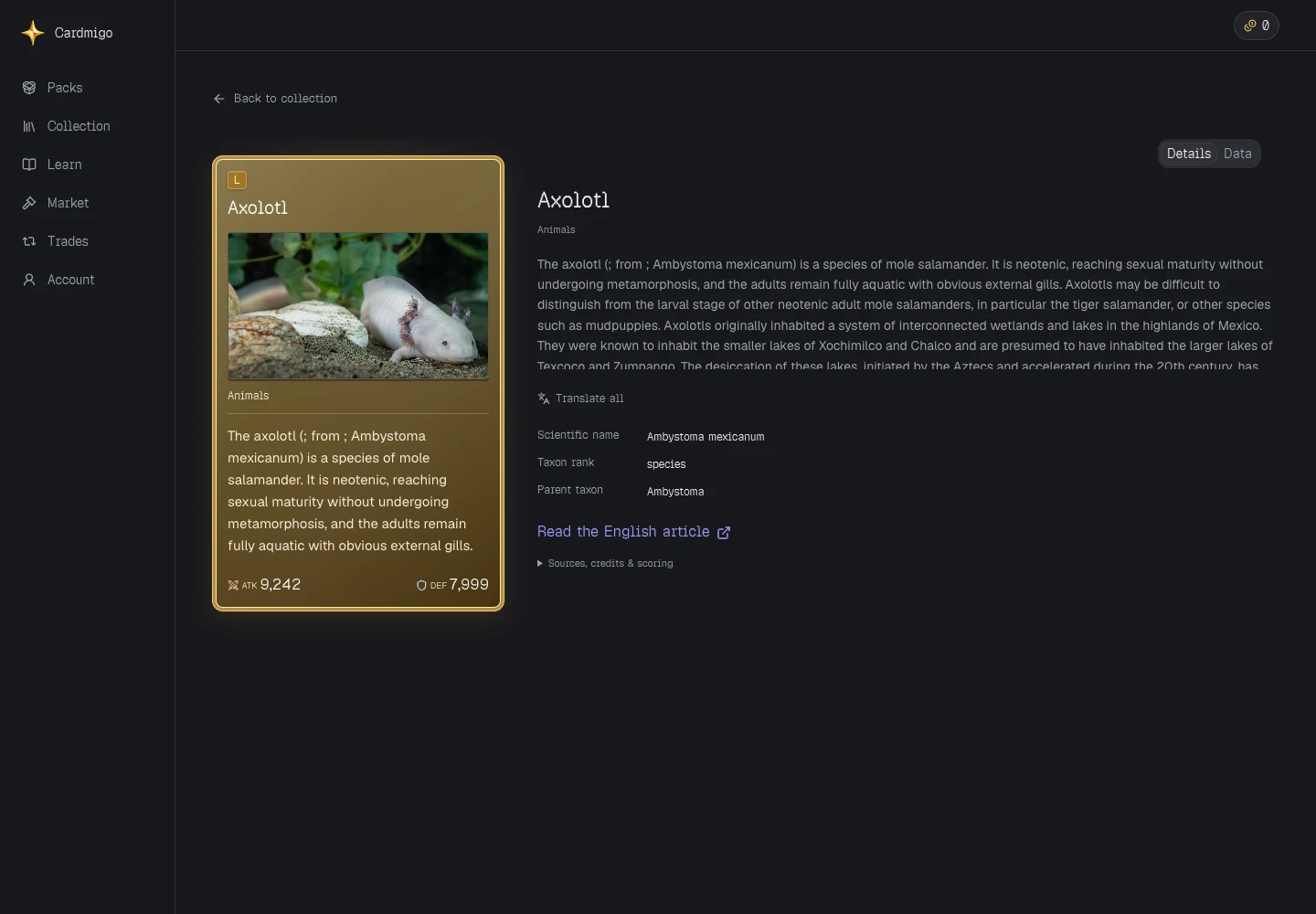
Axolotl
Axolotl Mattia Nocciola · CC BY-SA 4.0 · cropped to fit

Axolotl

A salamander that grows up without leaving its aquatic way of life. Its feathery external gills make the familiar idea of an adult amphibian feel surprisingly unfamiliar.

Follow the question: what does neoteny change about an animal’s life?

The real English Cardmigo Axolotl reading page
OkapiCharles Miller · CC BY 2.0 · cropped to fit

Okapi

Striped legs suggest a zebra; the family tree points to a giraffe. The okapi is a reminder that the most obvious resemblance is not always the closest relationship.

Follow the family tree: what makes an okapi a giraffe relative?

TardigradeThomas Shahan · CC BY 2.0 · cropped to fit

Tardigrade

Small enough to miss, interesting enough to spend an afternoon on. Some tardigrades can enter a low-activity state that helps these microscopic animals survive extreme conditions.

Read the limits too: survival in a dormant state is different from thriving.

Common cuttlefishDiego Delso · CC BY-SA 4.0 · cropped to fit

Common cuttlefish

Not quite a fish, and not just a pair of tentacles. This cephalopod can change its appearance, making camouflage a much more active process than simply having the right color.

Follow the surface: how does a cuttlefish change the way it looks?

Keep following the living world.

Compare a platypus’s sensory system with an axolotl’s life in water. Follow a pangolin from its scales to its diet. These reading connections are a starting point, not a checklist you need to finish.

These are real subjects in Cardmigo’s selected catalog. Reading a card does not add it to your collection; pack contents are random. The examples here do not promise a particular pull.

Take a detour into space ↗

Keep a little curiosity.

Open your free pack